 RUDIMENTS
16 / DIDDLE
Single Paradiddle
Combine two alternating singles and a double, then switch the leading hand.
No login · Free notation and synthesized audio
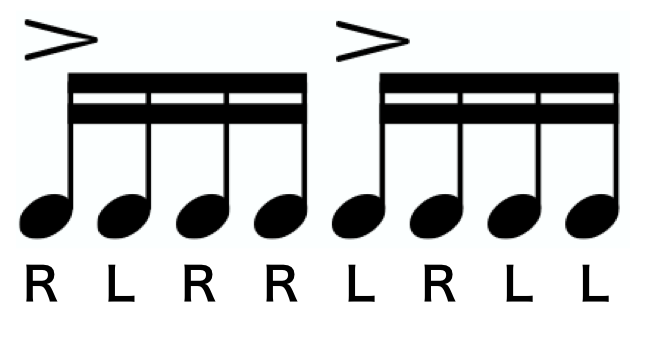
Synthesized tones illustrate sticking and dynamics: a higher tone for the right hand and a lower tone for the left. The metronome can be switched off. This is not a performance recording.
How to play a single paradiddle
Play two alternating single strokes followed by two strokes with the same hand. The first four notes start on the right; the next four start on the left. Keep the spacing even through each double and into the next group.
This player uses four sixteenth notes per metronome beat. Count 1 e & a, 2 e & a for the eight-note cycle. The guide accents the first note of each four-note group: right on beat 1, left on beat 2. Keep the other notes quieter without rushing the doubles.
A 5-minute paradiddle practice
Choose a comfortable tempo, such as 40 BPM; go slower if needed. In each minute, play for 40 seconds and rest for 20. These are practice suggestions, not speed targets.
- Minute 1 — Learn the sequence. Say the sticking while playing slowly. Check that each double has exactly two strokes.
- Minute 2 — Smooth the change of hand. Listen for a gap after each double. Keep all eight notes evenly spaced.
- Minute 3 — Shape the accents. Follow the guide's louder first note in each group. Keep the doubles quiet and controlled.
- Minute 4 — Check a small tempo change. If the pattern stays relaxed and even, stop playback and add 5 BPM. Otherwise repeat at the same tempo or lower it.
- Minute 5 — Finish cleanly. Return to your starting tempo and record a tempo you can repeat comfortably next time.
If doubles are uneven, spend a minute on the double stroke open roll, then return to the paradiddle. Avoid squeezing harder to keep up; reduce the tempo when control slips.
RUDIMENTS TRAINER APP
Make practice a habit.
After exploring the score and audio, adjust your tempo and review your practice time in the app.
Explore app features and how to practice →